














Table of Contents
- Understanding Leak-Proof vs Leak-Resistant: What the Claims Really Mean
- How Bagasse Containers Perform with Hot Foods
- Bagasse vs Kraft Containers: Which Handles Moisture Better
- Real-World Leak Testing: Methods That Work
- Lid Fit and Clamshell Design: The Critical Factor
- Delivery Handling and Packing Instructions
- Grease, Condensation, and Prolonged Liquid Exposure
- Choosing the Right Bagasse Container for Your Operation
- Frequently Asked Questions
Last Updated: October 6, 2026
Understanding Leak-Proof vs Leak-Resistant: What the Claims Really Mean
Marketing blurs the line: a "leak-resistant" container performs well normally but may fail under pressure, temperature changes, or prolonged moisture.
Leak resistance depends on three factors: the material, the lid fit, and how the food is packed.
The real question isn't whether a container claims to be leak-proof, but whether it performs reliably with YOUR food type, temperature, and delivery distance.
How Bagasse Containers Perform with Hot Foods
Hot foods create pressure inside a sealed container: steam rises, condenses on the lid, and pools, eventually escaping through gaps or weak points in the seal.
Bagasse containers handle hot foods reasonably well because sugarcane fibre insulates, so the lid stays cooler and the seal stays tighter longer.
For foods served above 60°C, pack with care:
- Leave a small gap in the lid to release steam gradually
- Don't seal completely until the food has cooled slightly
- Use containers with tight-fitting clamshell designs that clamp down firmly
The UK Food Standards Agency guidance on food safety during transport recommends maintaining safe temperatures throughout delivery, but condensation control is your responsibility.
Bagasse containers work best for hot foods when the lid fits snugly and packing accounts for steam. Our Bagasse 6x6" Clamshell Burger Box has a secure clamshell closure that grips firmly, reducing steam escape.

Bagasse vs Kraft Containers: Which Handles Moisture Better
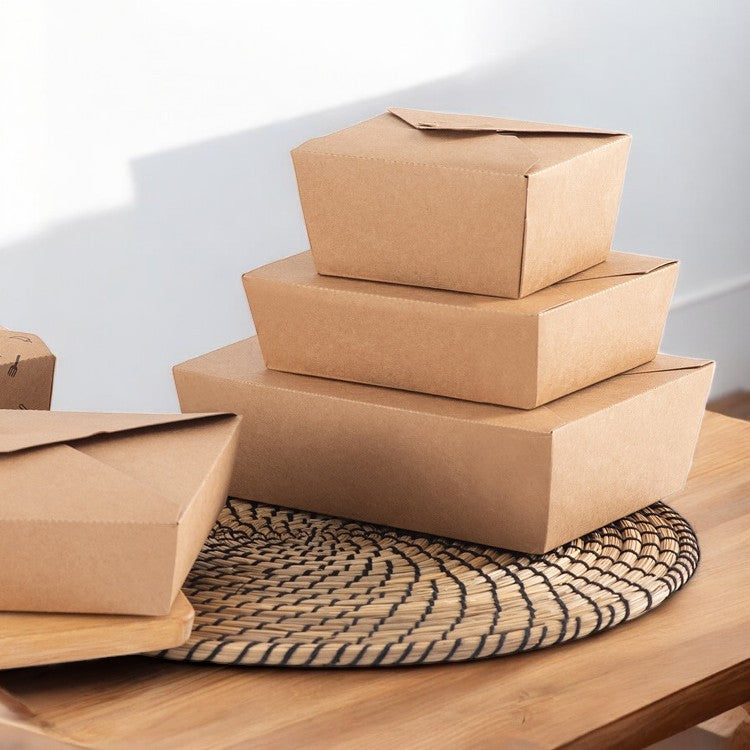
Kraft paper containers are lighter and absorb moisture; bagasse resists moisture better because it doesn't break down when wet. For delivery operations, this difference is significant.
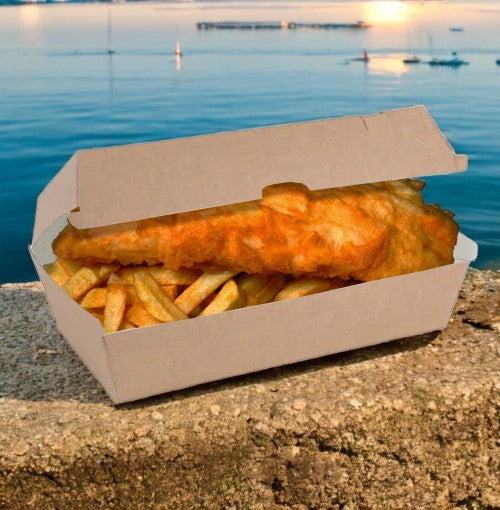
Kraft works for dry foods like sandwiches, pastries, and chips, but saucy or moist foods soak through within 30 minutes, weakening the container and lifting the lid.
Bagasse resists moisture longer because sugarcane fibre doesn't absorb liquid like paper.
Here's the practical breakdown:
| Food Type | Kraft | Bagasse |
|---|---|---|
| Dry items (sandwiches, pastries) | Works well | Works well |
| Saucy foods (curries, pasta) | Fails in 20-30 minutes | Resists 45-60 minutes |
| Greasy foods (fried items) | Fails in 30-45 minutes | Resists 60+ minutes |
| Cold, moist items (salads) | Fails in 40-50 minutes | Resists 60-90 minutes |
For delivery, bagasse wins on performance: its natural leak resistance to oils and sauces gives a wider safety window.
Real-World Leak Testing: Methods That Work
While bagasse containers are often marketed as leak-proof, most are leak-resistant rather than truly leak-proof, so the only reliable way to know how one behaves with your menu is to test it under conditions resembling your delivery route. A useful protocol has four variables: food type, fill level, temperature, and holding time. Change one at a time and record results.
A Practical Test Protocol
You don't need lab equipment, just a kitchen scale, timer, thermometer, shallow tray, and a way to hold the container at a fixed angle.
- Weigh the empty container and lid. Record the mass in grams.
- Fill with your actual menu item, not water, using your kitchen's portion size. Sauces, oils, and starches behave differently from water due to viscosity and surface tension.
- Fill to your normal level. Don't overfill, containers commonly leak at 80-90% fill because food touches the lid rim.
- Seal the lid using your packing team's motion, pressing the rim down evenly around the full perimeter.
- Weigh the sealed container. The difference from step 1 is your starting mass.
- Place it upright in a tray at room temperature for the first interval.
- Tilt to 45 degrees for the second interval, resting it against a support for a consistent angle.
- Invert fully for a short final interval if delivery risks the container being turned over.
- Weigh again at each interval. Any increase in outside mass, or liquid in the tray, is leakage.
Temperature and Holding Time Matrix
Run the same food at three temperatures and three holding times, nine data points per food type, enough to see a pattern without turning testing into a full-time job.
| Temperature | Typical use | What changes |
|---|---|---|
| Chilled (around 4°C) | Salads, cold desserts, deli items | Condensation forms on the inside of the lid; seals can stiffen |
| Ambient (around 20°C) | Bakery, dry goods, room-temperature meals | Baseline behaviour; fewest variables |
| Hot (around 70°C at packing) | Curries, stews, hot mains | Steam raises internal pressure; the lid can lift slightly as the container warms |
Holding times should match your real delivery window plus a buffer: for a 35-minute average route, test at 15, 35, and 50 minutes; for a 70-minute longest route, test at 30, 70, and 90 minutes.
Food Types to Test Separately
Don't assume one result covers your whole menu. Test at least one item from each group:
- Thin liquids, soups, broths, dhal. These find the smallest gap.
- Thick sauces, curry, bolognese, korma. These move slowly but can pool at the rim.
- Oily and greasy foods, fried chicken, chips, samosas. Oil can wick into the fibre and lubricate the seal.
Reading the Results
Record leakage as a category, not just yes or no:
- Dry, no visible moisture on the outside or in the tray.
- Mist, faint condensation on the outside surface only.
- Seep, a visible bead or film of liquid at a seam or corner.
A container that stays dry or shows only mist across your full delivery window is reasonable for that food. One that seeps or drips before your window ends is unsuitable at that fill level and temperature, regardless of packaging claims.
Lid Fit and Clamshell Design: The Critical Factor
A container's leak resistance lives or dies with the lid fit: a loose clamshell will leak regardless of material.
Bagasse clamshell containers rely on friction to stay sealed: the lid's rim grips the container's edge, and if that rim is worn, damaged, or poorly manufactured, the seal fails immediately.
Check your containers before ordering bulk:
- Press the lid down firmly and hold for 5 seconds
- Listen for a subtle "click" or feel resistance in the closure
- Inspect the rim for cracks, gaps, or warping
A well-designed clamshell like our Bagasse 9x6" Clamshell Meal Box has a tight-fitting lid that clamps down securely, with moulded sugarcane fibre creating a consistent rim that grips evenly around all sides.

Poor-quality clamshells have loose rims or uneven closure and leak almost immediately under pressure or tilt. The material doesn't matter if the design fails.
Delivery Handling and Packing Instructions
Leak-resistant containers only stay leak-resistant if packed and handled correctly. Your delivery team's method matters as much as the container itself.
Bagasse 6x6" Clamshell Burger Box 152x152x78mm Pack 500 →
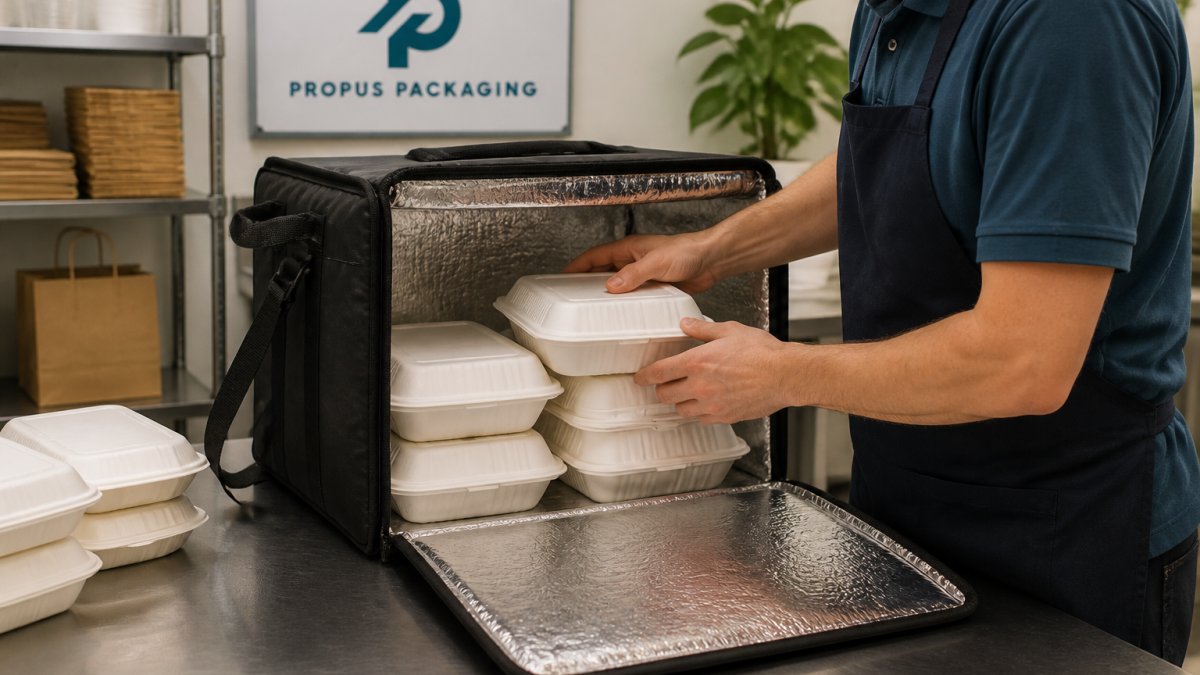
Pack bagasse containers upright in insulated delivery bags, never stacked flat or at angles, since stacking pressure changes how the lid seals.
For multiple containers in one delivery:
- Use dividers or cardboard separators to prevent shifting
- Place heavier containers on the bottom
- Avoid overstuffing the delivery bag
Temperature control affects condensation: keep hot foods in insulated bags with heat retention, and cold foods in insulated bags with ice packs or cooling elements.
Communicate delivery times to your team. A 20-minute delivery creates different conditions than a 60-minute delivery.
Grease, Condensation, and Prolonged Liquid Exposure
Water resistance, grease resistance, and leak resistance are three different properties. Bagasse is a moulded fibre material, so it interacts with liquids differently from plastic or foil-lined board, understanding the mechanisms helps you predict when a container will fail.
How Grease Behaves in Moulded Fibre
Moulded sugarcane fibre is microscopically porous. Hot oil or melted fat lowers surface tension, letting it wick into the fibre matrix faster than water, which is why a container that holds watery soup can show a grease ring after 40 minutes with fried food.
Two things happen as grease wicks in:
- The fibre softens. Oils act as a plasticiser, reducing stiffness. A softened rim grips the lid less firmly.
- The seal is lubricated. Grease at the lid rim reduces friction between lid and container edge. A clamshell that relies on friction can begin to lift.
This is why greasy foods often fail at the rim rather than through the base. The base has more material and no closure to compromise.
How Condensation Creates Pressure
When hot food is sealed into a container, water vapour fills the headspace and condenses on the cooler lid as it cools during delivery. Two effects follow:
- A partial vacuum forms. Condensing vapour reduces internal pressure, which can pull the lid tighter, or, if the lid is already loose, allow it to shift.
- Liquid pools at the lowest point. In a tilted delivery bag, that pool sits against one side of the rim. If the rim has any gap, the pool finds it.
Condensation isn't visible from outside, so it's easy to underestimate: a container that looks dry can be holding a pool of water against the inside of the lid.
Prolonged Exposure and Hold Time
Every bagasse container has a practical hold time for a given food, beyond which resistance declines through softening and wicking.
A useful way to think about it:
- 0-30 minutes, most well-sealed bagasse containers hold thin liquids and sauces without visible leakage.
- 30-60 minutes, grease and thin liquids begin to show at seams and rims in lower-quality containers; well-made clamshells often still hold.
- 60-90 minutes, condensation pools, grease has wicked into the rim, and the seal is at its most vulnerable.
These are patterns, not guarantees. Your container, fill level, and food composition will shift the boundaries.
Failure Modes to Watch For
When a delivery fails, the cause is usually one of these:
- Rim wicking, grease or sauce has travelled through the fibre at the lid seam.
- Seal lift, steam pressure or lubricated friction has allowed the lid to rise slightly.
- Corner pooling, liquid has collected in a low corner during transport and found a gap.
Reducing the Risk
You can extend a moulded fibre container's safe hold time:
- Separate liquids from solids where the menu allows, sauce in a small pot, solids in the main container.
- Avoid overfilling. Leave headspace so food does not touch the lid rim.
- Use a secondary barrier for very saucy or greasy items, a liner, a bag, or a nested container.
Choosing the Right Bagasse Container for Your Operation
Select containers based on your actual menu and delivery conditions, not marketing claims.
For dry foods and short deliveries (under 30 minutes), almost any bagasse container works. Our Bagasse 7x5" Clamshell Meal Box handles standard takeaway items reliably.

For saucy or moist foods with longer delivery times (30-60 minutes), choose containers with tight-fitting clamshell designs. The Bagasse 8x8" Clamshell Meal Box provides secure closure and adequate space for substantial portions.
For high-volume delivery operations, consistency matters most. Order from suppliers who maintain strict quality control.
Test a sample batch before committing to bulk orders: pack your actual menu items, simulate delivery conditions, and document the results.
Bagasse containers are leak-resistant, not leak-proof.
Bagasse containers work best when you understand their real limits.
Frequently Asked Questions
Are bagasse containers truly leak-proof for delivery, or just leak-resistant?
Bagasse containers are leak-resistant rather than completely leak-proof. The natural fibre structure and tight-fitting clamshell lids provide strong resistance to oils, sauces, and moisture, but they are not impervious to leakage under all conditions. Performance depends on food type, temperature, holding time, and how containers are packed. Saucy or moist foods held for extended periods may eventually cause minor seepage, especially if condensation builds up inside. Proper packing and handling significantly improve leak prevention during delivery.
How do bagasse containers for hot food compare to kraft when handling steam and condensation?
Bagasse containers for hot food manage steam and condensation. The sugarcane fibre structure has natural water-resistant properties that resist oil penetration and moisture absorption. However, prolonged exposure to steam inside a sealed container can still cause condensation to pool at the base. To minimise this, leave a small gap in the lid during the first few minutes after packing hot food, then seal fully. Bagasse's durability means it won't soften or lose structural integrity when exposed to heat and moisture.
What's the best way to test takeaway containers for leaks before using them at scale?
Test containers by filling them with water or a sauce-like liquid (olive oil mixed with water works well) at the temperature you'll actually use. Seal the lid firmly and let sit for 15-20 minutes to simulate delivery time. Tilt and shake gently, then check for any moisture on the outside or seepage around the lid. Repeat with hot food to test condensation behaviour. For your specific menu items, conduct tests with actual sauces, gravies, or curries you serve. Run these tests on multiple containers from different batches to check for consistency. This real-world approach reveals weaknesses in lid fit or container integrity before they affect customer orders.
Why does lid fit matter so much for leak prevention in bagasse containers?
The lid's seal is the primary barrier against leakage. A loose or poorly fitting lid allows liquid and steam to escape around the edges, defeating the container's natural water resistance. Bagasse clamshell designs rely on a tight mechanical fit rather than a rubber gasket, so even small gaps compound the problem during delivery. When stacked or jostled, a loose lid can shift further, increasing leakage risk. Always check that lids snap firmly closed with an audible click, and ensure you're using matching lid and container sets from the same product line. Mismatched sizes or worn containers will compromise seal integrity significantly.

