














Table of Contents
- Understanding Kraft Paper Food Containers for Wholesale Purchasing
- Kraft Food Container Sizes and Capacities: Finding the Right Fit
- Kraft Food Bowls With Lids: Leak-Resistance and Heat Retention
- Bulk Food Packaging Supplies: Calculating Wholesale Costs and Volume Discounts
- Custom Printed Kraft Food Containers: Branding and Lead Times
- Food-Contact Safety and Material Verification
- Selecting a Reliable Wholesale Supplier: Stock, Delivery, and Support
- Frequently Asked Questions
Last Updated: October 5, 2026
Understanding Kraft Paper Food Containers for Wholesale Purchasing
Packaging is your brand's first impression. Kraft paper food containers wholesale options have become the go-to choice for restaurants, cafés, and catering operations because they balance cost, durability, and sustainability.
Kraft packaging keeps hot food hot, cold food cold, and your branding visible. The challenge is finding a wholesale supplier that stocks what you need, delivers on time, and prices fairly.
Kraft Food Container Sizes and Capacities: Finding the Right Fit
The biggest mistake is buying containers that don't match your actual portion sizes. A 500ml container too small for your signature salad short-changes customers; a 1000ml bowl for a small dessert wastes space and drives up per-unit costs.
Small Containers (300-400ml): Desserts, Sauces, and Sides
Small kraft food containers suit sauces, dips, small desserts, and side portions. They keep costs low by using less material and are ideal for delivery, where bag space matters.
They fit easily in a standard delivery bag, and many cloud kitchens and dessert-focused operations rely on them for profitability. PE-lined kraft construction keeps contents secure without the weight or cost of larger options.
Medium Containers (500-750ml): Main Courses and Salads
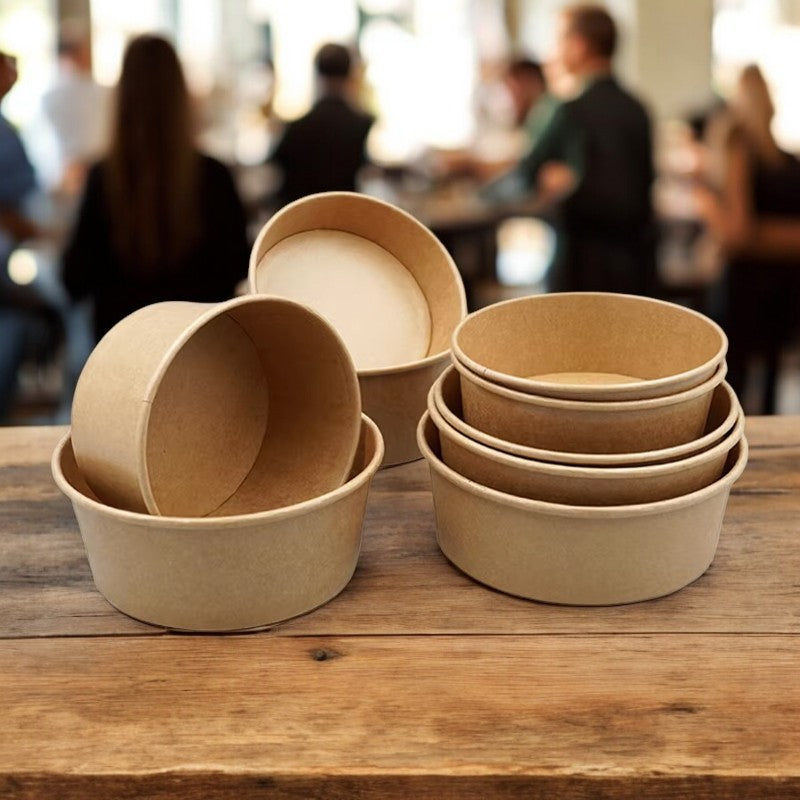
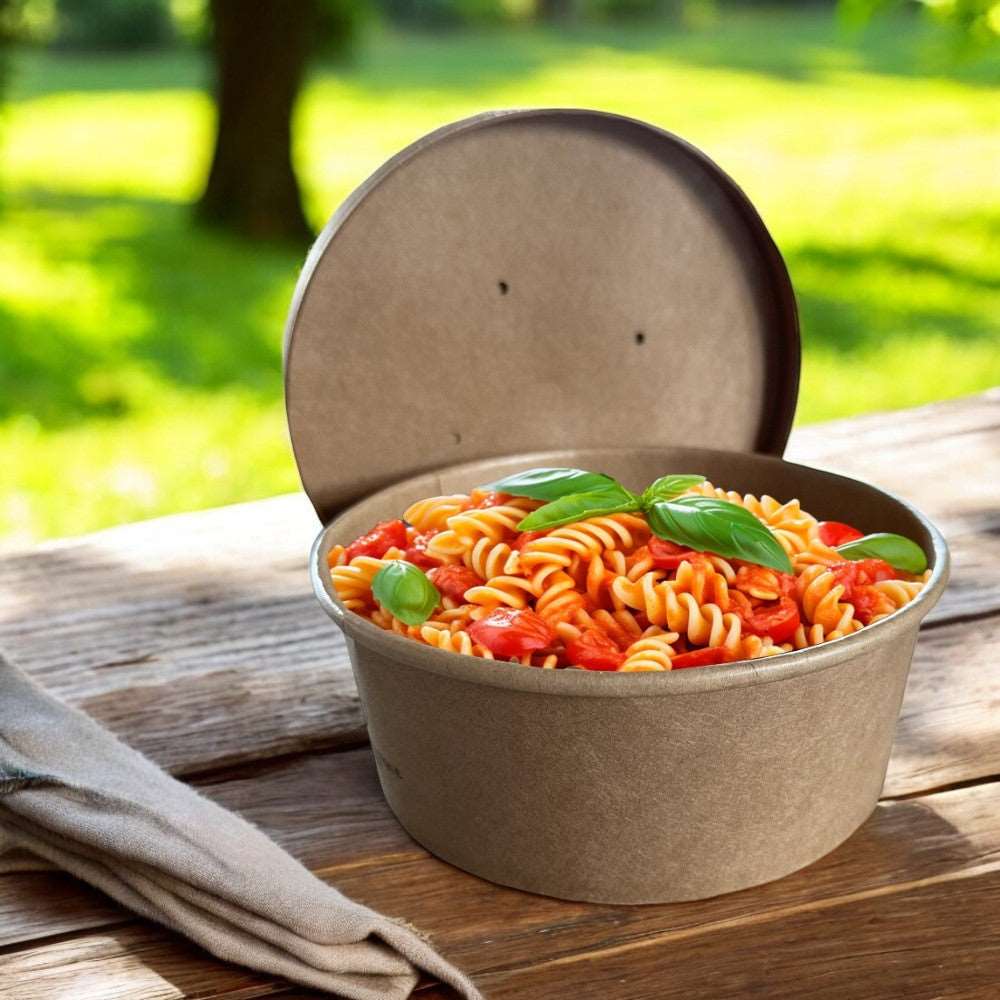
This is the sweet spot for most food businesses. The Kraft 500ml Round Bowl With Kraft Lid Pack 300 at £47.50 per pack works out to roughly 16p per unit in bulk.

The 750ml option steps up for larger portions or family-size salads. At £49.50 per pack of 300, the Kraft 750ml Round Bowl With Kraft Lid Pack 300 gives more capacity without a dramatic cost increase.

Large Containers (950ml-1200ml): Family Portions and Bulk Orders
For family-size portions or catering orders, larger containers become essential. The Kraft 1000ml Round Bowl With Kraft Lid Pack 300 at £52.50 per pack handles substantial portions while remaining stackable for delivery and storage.

You serve fewer units per order at this capacity, so the higher per-unit cost is offset by larger sale value.
Kraft Food Bowls With Lids: Leak-Resistance and Heat Retention
The lid is where many businesses discover they've made the wrong choice. A container without a proper seal means damaged food, complaints, and reputational damage.
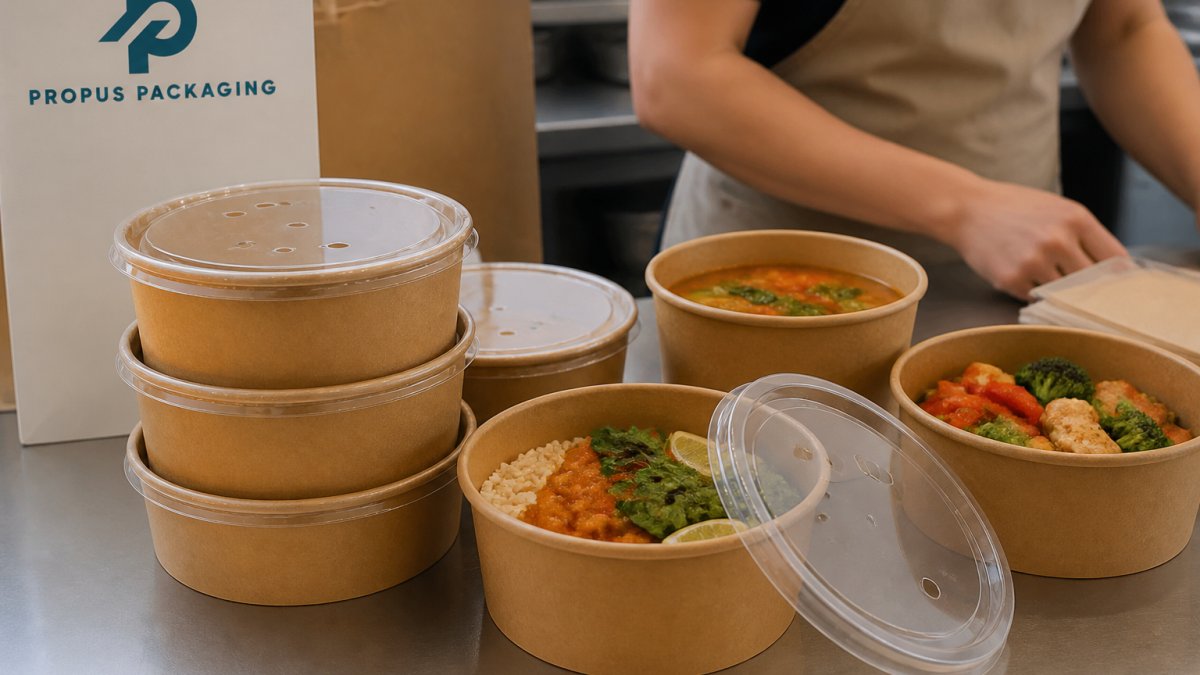
PE-Lined Kraft Bowls and Vented Lid Design
PE-lined kraft construction is the industry standard because it creates a moisture barrier plain kraft cannot. The plastic lining stops grease and liquid soaking through the paper, which is non-negotiable for hot foods, curries, or anything with sauce.
Vented lids are equally critical. Small perforations let steam escape gradually, preventing condensation from dripping back onto your food. Without venting, you get soggy fries and waterlogged salads.
Testing for Leaks Before Large Orders
Before committing to a large wholesale order, test the containers with your real food. Fill a bowl with your sauciest item, seal the lid, turn it upside down, and leave it for 10 minutes.
A container that works fine with dry items might fail with soup or curry. Testing takes 15 minutes and prevents weeks of complaints and refunds.
Bulk Food Packaging Supplies: Calculating Wholesale Costs and Volume Discounts
Pack price is what suppliers advertise; landed cost decides whether your margins hold. The gap between them is where most food businesses quietly lose money on packaging.
From Pack Price to Landed Unit Cost
Start with the basic division: a pack of 300 bowls at £47.50 is roughly 16p per unit; a pack of 250 tubs at £27.50 is 11p per unit.
Landed cost adds four things the pack price ignores:
- Delivery charges. A flat £6.95 next-working-day charge on a single pack of 300 bowls adds about 2.3p per unit; on a five-pack order, under 0.5p. Delivery cost per unit falls as order size rises, so small frequent orders are the most expensive way to buy.
- Minimum order thresholds. If a supplier waives delivery above a set spend, the cheapest order is often the one that just clears that threshold.
- Storage cost. Containers occupy space. If that space displaces something else, or you pay for it, it belongs in the calculation.
A simple landed-cost formula:
(Pack price + share of delivery + share of any surcharge) ÷ usable units per pack = landed unit cost
Run that for each supplier and pack size. The supplier with the lowest pack price is frequently not the one with the lowest landed unit cost.
Comparing Pack Sizes Honestly
Wholesale kraft containers commonly arrive in packs of 250 or 300, and case quantities vary. To compare fairly, normalise everything to a single unit:
- Write down the pack price and exact unit count.
- Divide to get the raw unit price.
- Add the delivery cost per unit at your realistic order size.
- Note the minimum order quantity and any surcharge below it.
- Compare landed unit cost, not the headline pack price.
A worked comparison: Supplier A sells 300 bowls for £47.50 with £6.95 delivery and no minimum. Supplier B sells the same bowl at £45.00 per 300 but requires a £150 minimum and charges £9.95 delivery. If you need one pack, Supplier A lands at roughly 18p per unit; Supplier B isn't available without over-ordering.
Volume Planning, Reorder Schedules, and Break-Even
Forecast monthly usage from covers, not optimism. Serving 200 meals a day across six days is roughly 5,200 containers a month before waste, breakage, or double portions.
Set a reorder point rather than a date.
Calculate break-even between pack sizes once. If a larger pack lowers unit price but you can't use it before the paperboard degrades, the saving is illusory.
Kraft 500ml Round Bowl With Kraft Lid Pack 300 →
Questions to Ask Before You Commit
- What is the exact unit count per pack, and does it vary between products?
- What is the delivery charge, and at what order value is it waived?
- Is there a minimum order quantity or small-order surcharge?
Clear answers to those six questions turn a pack price into a landed cost you can plan around.
Custom Printed Kraft Food Containers: Branding and Lead Times
Custom branding transforms packaging from functional to memorable. Your logo, business name, and colours on every container make every delivery a brand touchpoint.
The critical question is lead time. Custom printing takes longer than standard kraft containers.
Order custom containers on realistic forecasts. A 5,000-unit order sitting in storage for six months costs more than the printing itself.
Food-Contact Safety and Material Verification
Anything touching food is regulated, and responsibility for compliant packaging sits with the food business, not only the supplier. Understanding what "food-contact safe" means, and how to verify it, protects your customers and your operation.
What Food-Contact Safety Means in Practice
In the UK, food-contact materials are governed by food-contact materials legislation, with safety requirements in retained food safety law enforced by local authority trading standards and environmental health teams.
For kraft paper containers, that principle translates into two questions:
- Is the paperboard itself suitable for food contact?
- Is the coating or lining suitable for food contact, and is it appropriate for the type of food you are serving?
A container can be made from food-grade paperboard and still be unsuitable for hot, greasy, or acidic food if the lining is wrong for that application.
Coatings and Linings: What They Do and What They Cost You
Unlined kraft paperboard is absorbent: it wicks moisture and oil, softens, and can fail structurally within minutes with wet or greasy food.
- PE (polyethylene) lining. The common choice for hot and oily food, forming a moisture and grease barrier and handling heat well. Its drawback is disposal: the plastic layer is bonded to the paper, complicating recycling in many waste streams.
- Water-based or dispersion coatings. A recyclability-friendly alternative providing a grease and moisture barrier without a separate plastic film. Performance varies by product and food type, so they are not a universal swap for PE.
- Uncoated kraft. Suitable only for dry goods such as bakery items, pastries, and pre-packaged snacks, not hot food, sauces, or anything with significant moisture or oil.
The trade-off is real: the coating that performs well with hot curry often complicates disposal. Choose based on what you serve, then check the disposal route available to your customers.
Documentation to Request from a Supplier
Broad claims such as "food-friendly" or "food-safe" are not verification. Ask for specifics:
- A declaration of compliance for the food-contact material, stating intended use conditions (hot fill, fatty foods, aqueous foods) and temperature limits.
- Details of the coating or lining, including whether it is approved for the food types you serve.
- Migration testing information where available, confirming the material has been assessed for substance transfer into food under intended conditions.
A reputable supplier provides this without hesitation. Reluctance, vagueness, or refusal to state the lining material is a reason to look elsewhere. Keep the documentation on file in case a customer or enforcement officer raises a question.
Matching the Container to the Food
Food-contact suitability is a match between material and conditions of use:
- Hot, oily, or saucy food needs a barrier lining rated for heat and fat contact.
- Acidic food, such as tomato-based dishes or dressings, can attack some coatings more aggressively than neutral food.
- Cold and dry food can often use a lighter or uncoated option.
If unsure whether a container suits a dish, test it under realistic conditions before ordering in bulk, and ask the supplier to confirm the intended use range in writing.
Disposal Claims: Read Them Carefully
"Recyclable", "biodegradable", and "compostable" are not interchangeable, and the coating often determines which claim genuinely applies.
- Recyclable means the material can be processed in an appropriate recycling stream. For lined kraft containers, that depends on whether your local authority or commercial waste contractor accepts them and whether the lining can be separated or tolerated in the paper stream.
- Biodegradable means the material can break down biologically, but says nothing about how long that takes or whether it happens at home or industrially.
- Compostable usually refers to a specific standard and conditions, often industrial composting, which may not be available locally.
A claim can be technically true but practically unusable if the required waste facility doesn't exist locally. Check what customers can actually do with the container before building a marketing message around its disposal; if the claim depends on inaccessible facilities, describe the container accurately rather than overstating its end-of-life credentials.
Selecting a Reliable Wholesale Supplier: Stock, Delivery, and Support
The right supplier does more than fill orders: they keep stock available, deliver on schedule, and support you when problems arise.
Stock availability matters more than you'd expect.
Delivery reliability is equally important.
Support quality reveals itself when problems occur. A supplier who answers the phone, solves issues quickly, and stands behind their product is worth paying slightly more for.
At Propus Packaging, we've built our business on these challenges.
Frequently Asked Questions
What are kraft paper food containers used for?
Kraft paper food containers are designed for serving hot and cold takeaway meals, from salads and desserts to main courses and bulk catering. The PE-lined kraft paperboard makes them durable and leakproof, suitable for food delivery, restaurant takeaway, cloud kitchens, and catering events. They retain heat effectively and are widely used by independent cafés, restaurants, and food vendors.
How do I choose the right size kraft food container for my menu?
Match container capacity to your portion sizes. Small 300-400ml containers suit desserts and sides; 500-750ml bowls work for salads and main courses; 950ml-1200ml containers handle family portions and bulk orders. Test your typical portions in each size before ordering wholesale quantities. This prevents overfilling (which risks leaks during delivery) and reduces packaging waste.
Are kraft paper food containers suitable for hot food and delivery?
Yes. Kraft paper containers with PE-lined interiors are designed for both hot and cold food. The vented lids retain heat while allowing steam to escape, preventing condensation that can soften the container. The PE lining provides leak-resistance during transport. Always test lids for a secure fit and monitor delivery times to ensure food stays at safe temperatures.
What should I check before buying kraft food containers wholesale?
Verify material specifications (PE-lined kraft paperboard meets food-contact standards), test lid fit and leak-resistance with your actual food items, confirm pack quantities and per-unit pricing align with your volume needs, check supplier delivery times and stock availability, and review sustainability claims if eco-friendly packaging is important. Request samples and test performance in your delivery conditions before committing to bulk orders.

